The document is still on the glass. The printer doesn't care. This invention does.
It happens dozens of times a day in every busy office: someone runs a scan or a photocopy, the machine finishes, and they walk away — leaving the original document face-down on the glass. A bank statement. A signed contract. A passport copy. The next person walks up, lifts the lid, and finds it. Sometimes they hand it in. Sometimes they don't.
For decades, the printer industry's answer to this problem has been: nothing. High-end enterprise machines have document-detection sensors, but they come at a premium that most small offices, schools, and government departments cannot justify. The overwhelming majority of the world's printers and photocopiers have no mechanism whatsoever to alert a user that they've left something behind.
A patent filed in 2025 proposes a fix so simple it raises the question: why did it take this long? A small circuit — a capacitor, a resistor, a relay, and an LED — that costs a fraction of what any smart sensor costs, requires zero changes to the machine's software, and alerts you the moment your scan is done.
No firmware. No Wi-Fi. No app. Just a glowing LED that stays on until you come back for your document — even after the machine has powered itself off.
The Problem Is Bigger Than It Looks
In shared workspaces, libraries, hospitals, and government offices, a forgotten document is not just an inconvenience — it is a data security incident. Patient records, financial statements, legal filings, identity documents: all of these pass through photocopiers and scanners every day, and all of them are vulnerable to being left behind.
The market reality makes the problem worse. Most of the world's printer fleet consists of low-to-mid-range models sold by the millions — the HP DeskJets, Canon Pixmas, and Epson Eco-Tanks of the world. These machines have no document-presence sensor, no post-scan check, and no alert system of any kind. When the job finishes, the machine goes quiet. Whether your document is still on the glass is entirely your problem.
Enterprise machines that do offer this feature build it into their firmware and proprietary hardware at significant cost — and they are, by definition, not retrofittable to the devices already in the field. There is no upgrade path. You either buy a new machine or you accept the risk.
There are hundreds of millions of printers in use worldwide with no mechanism to tell users their document is still inside. This patent is designed for every single one of them.
The Invention: Elegant, Minimal, Effective
The alert system is built around a single insight: the scanner head already travels to a precise end position when a job finishes. That mechanical fact — the head reaching a known location — is all the system needs to know that a job is done. Everything else follows from there.
How It Works
A mechanical trigger switch (SW1) is positioned at the scanner head's end-of-travel point. When the head completes its sweep and reaches that position, the switch closes. This is the only 'smart' element in the entire system — everything else is passive electronics.
The switch closing allows a charged 4700 µF capacitor to discharge through a 150 Ω resistor and a 2.2V LED. The LED glows. An optional buzzer sounds. The user is alerted. The capacitor sustains the alert for up to 1.5 minutes — long enough to catch anyone who has stepped away briefly, and crucially, long enough to persist even if the machine powers itself off in that window.
Power comes from the printer's own 12V DC SMPS supply, tapped without disturbing the main board. A Single Pole Single Throw (SPST) relay isolates the alert circuit entirely, meaning the system draws from the machine's power without ever interfering with it. Total current draw: approximately 6.5 mA — less than a typical status indicator LED on the machine itself.
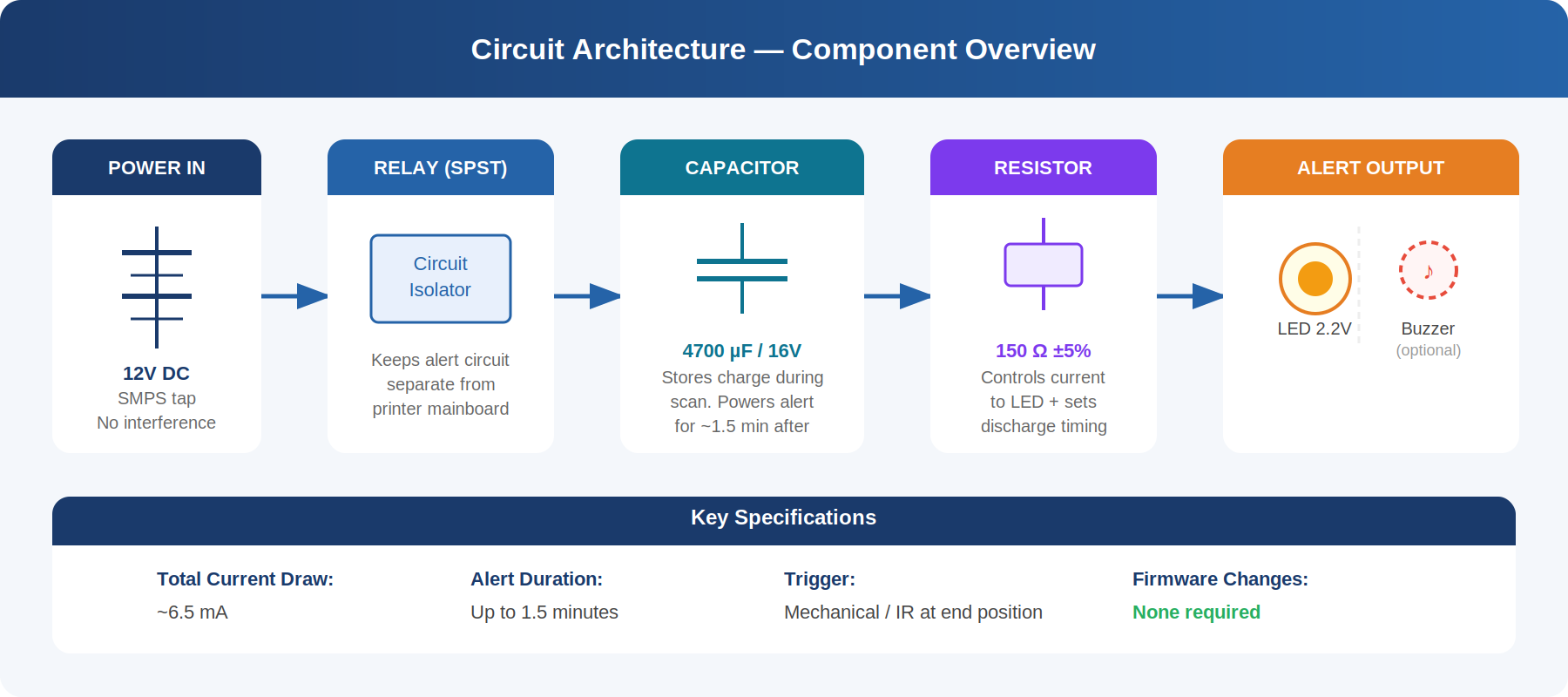
Circuit Architecture
The entire system is built from five components, each with a specific and well-defined role:
| Component | Specification & Role |
|---|---|
| 12V DC Power Supply | Tapped from printer SMPS — no mainboard interference |
| SPST Relay | Isolates alert circuit; protects printer electronics |
| Capacitor (C1) | 4700 µF / 16V — stores charge, powers alert for ~1.5 min |
| Resistor (R1) | 150 Ω ±5% — controls LED current and discharge rate |
| LED (D1) | 2.2V, 20mA — visual alert indicator |
| Speaker/Buzzer (SP1) | Optional 1.5V buzzer for audible alert |
| Trigger Switch (SW1) | Mechanical switch at scanner end-position — zero firmware |
| Total Current Draw | ~6.5 mA — minimal impact on machine power budget |
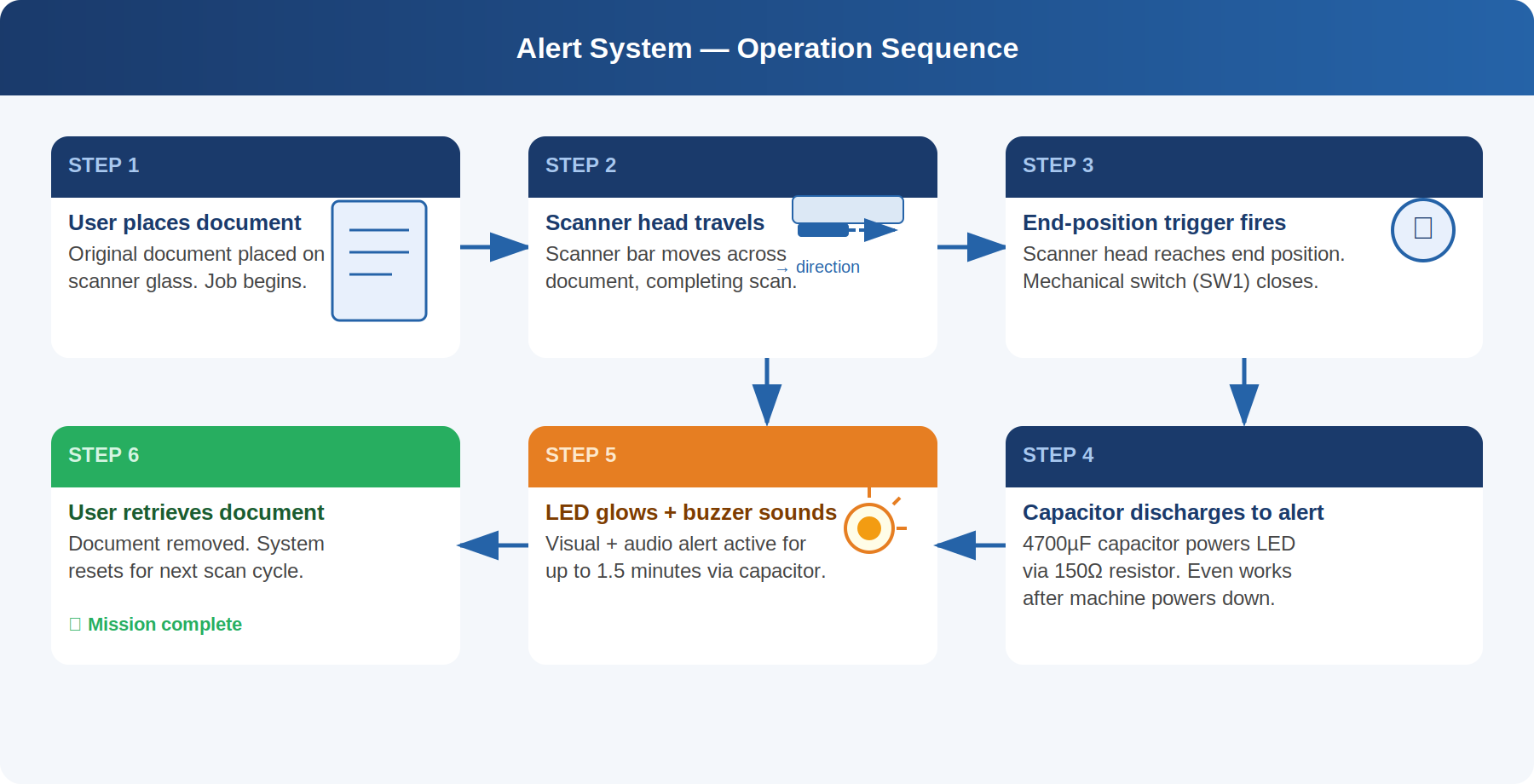
Step by Step: From Scan Complete to Document Retrieved
| Step | Operation & Description |
|---|---|
| 1 | Scan or copy job begins User places original document on scanner glass and initiates the job. The 12V circuit is live, capacitor is charging. |
| 2 | Scanner head traverses the document The scanner bar moves across the glass in its normal operating direction. The relay is in its normal (open) state. |
| 3 | Head reaches end position — trigger fires The scanner bar reaches its mechanical end-of-travel. The trigger screw closes switch SW1. The alert circuit is now active. |
| 4 | Capacitor discharges through resistor to LED The 4700µF capacitor begins discharging through the 150Ω resistor, illuminating the LED. The buzzer sounds if fitted. This continues even if the machine powers down. |
| 5 | Alert persists for up to 1.5 minutes The LED remains lit, powered solely by the capacitor's stored charge. Duration is determined by the RC time constant — approximately 90 seconds. |
| 6 | User retrieves document — circuit resets Document is removed. System is ready for the next scan cycle. No manual reset required. |
Why No Firmware? That's the Point.
The most significant design decision in this invention is also the one that makes it universally deployable: the system requires zero modification to the printer's software or firmware.
Almost every printer on the market today runs proprietary, closed firmware that cannot be modified by end users or third-party manufacturers without voiding warranties or violating licensing agreements. Any solution that required firmware access would immediately be ruled out for the vast majority of the installed base.
By anchoring the entire system to a single mechanical trigger — the scanner head's end-of-travel — the invention sidesteps the firmware problem entirely. The machine does not need to know the alert system exists. It does not need to signal it, coordinate with it, or acknowledge it in any way. The alert system simply observes the mechanical fact of job completion and acts on it independently.
The printer is not made smarter. The environment around it is — and that is a far more scalable approach.
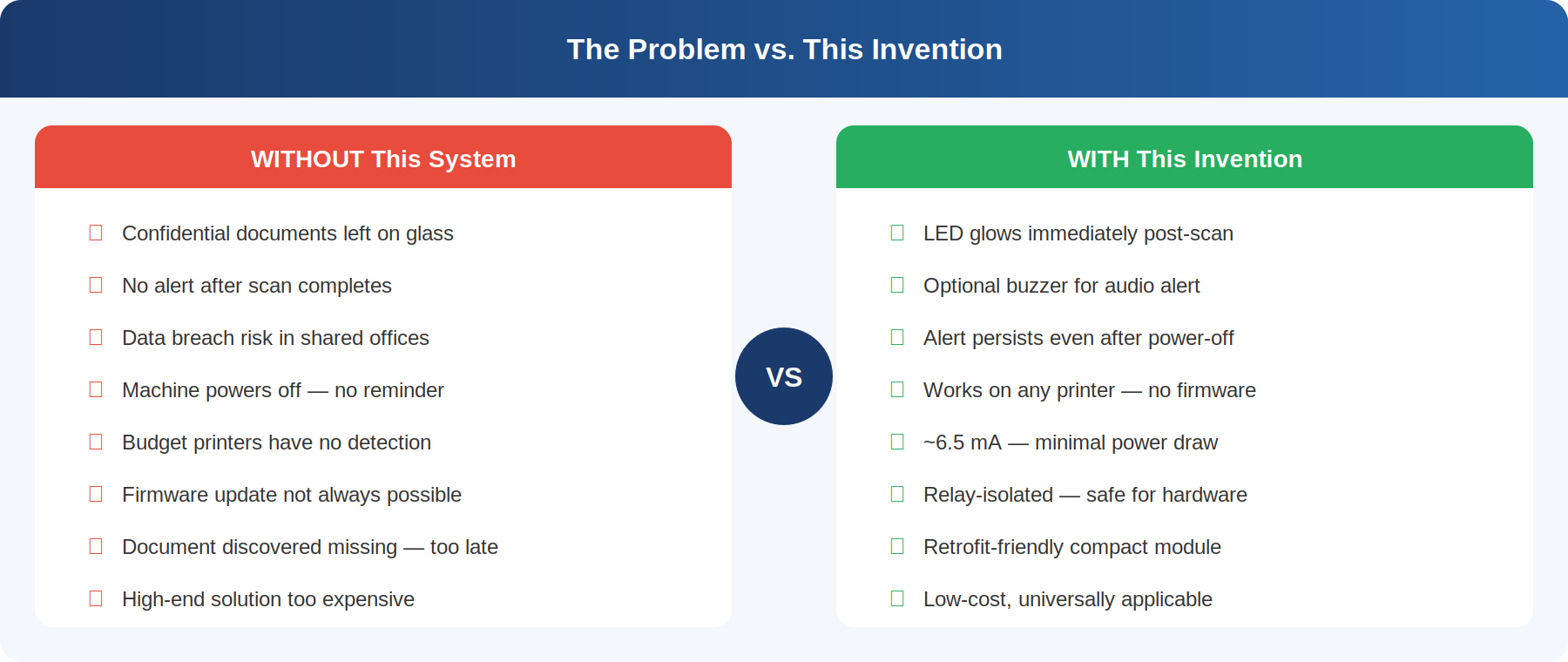
Problem vs. This Invention
Below is a side-by-side comparison of the gap in existing printers versus what this invention addresses.
Key Innovations
The capacitor stores charge during the scan and continues powering the LED even after the machine's main power is cut — covering the common scenario where the printer auto-powers-off.
The SPST relay ensures complete electrical isolation between the alert module and the printer's mainboard, protecting both from interference.
The mechanical trigger makes the system compatible with any printer or photocopier, regardless of manufacturer, model, or software version.
The entire circuit is compact enough to fit within existing machine enclosures, enabling both factory integration and field retrofitting.
Five standard electronic components. No microcontroller, no wireless module, no proprietary sensor. The cost of materials is a fraction of any competing approach.
At ~6.5 mA total draw, the system adds negligible load to the printer's power supply — well within the headroom of any SMPS-equipped machine.
An upgraded variant can add an IR or mechanical sensor to confirm the document is actually still present before firing the alert, eliminating false positives.
Patent Filing Details
| Specification | Details |
|---|---|
| Title | Alert System for Detecting Unretrieved Original Documents in Printers and Photocopiers |
| Lead Inventor | Kartikey Kumar |
| Co-Inventors | Dr. Vipin Kaushik, Dr. Sumit Sharma, Dr. Khushbu Yadav |
| Application | Complete Patent Specification filed |
| Field | Office Automation / Consumer Electronics / Document Security |
| Status | Under Examination |
Where This Can Be Deployed
Because the system requires no firmware access and draws power solely from the machine's existing 12V supply, it is deployable across an extraordinarily wide range of scenarios:
- Office photocopiers and MFD (multi-function device) scanners
- Low-cost home printers retrofitted as a hardware add-on
- Hospital and clinic document stations handling patient records
- Government office counters processing identity and legal documents
- School and university reprographic centres
- Bank branches and financial services desks
- New printer/scanner models as a factory-integrated module
The Broader Point
The history of useful inventions is full of solutions that look obvious in hindsight. A glowing LED powered by a capacitor, triggered by the scanner head reaching the end of its travel — that is, in technical terms, nearly trivial. But the problem it solves has existed for as long as photocopiers have existed, and the industry's answer has consistently been to either ignore it or price the solution out of reach for the vast majority of users.
This invention's contribution is not a technical breakthrough in the classical sense. It is a design insight: that the right sensor was already present (the mechanical end-stop), the right power source was already available (the SMPS), and the right alerting medium was already cheap (the LED). The invention is the recognition that these three facts, combined, are sufficient to solve the problem — and the decision to actually combine them.
Sometimes the most valuable patent is not the one that introduces new technology. It is the one that finally uses what was already there.
The inventors are exploring licensing and manufacturing partnerships with printer OEMs, document management solution providers, and office equipment distributors. The module is designed to be manufacturable at scale, integrable at the factory level, and retrofittable in the field.
About the Inventors
Kartikey Kumar is the lead inventor and the author of this article. The invention was developed alongside co-inventors Dr. Vipin Kaushik, Contact: kartikeyjaiswal42@gmail.com
Comments
Post a Comment